Endpoint Privilege Manager
Remove local admin rights, enforce least privilege, and implement foundational endpoint security controls across all Windows, macOS and Linux endpoints from hybrid to cloud environments.
Implement proactive, preventative controls
Secure all endpoints: managed, unmanaged and servers
Remove Local Admin Rights
Reduce the endpoint attack surface by removing local admin rights
Endpoint Privilege Manager helps remove local admin rights while improving user experience and optimizing IT operations. Flexible policy-based management simplifies privilege orchestration and allows controlled Just-In-Time maintenance sessions.


Enforce Least Privilege
Extend Identity Security and Zero Trust to endpoints
Comprehensive conditional policy-based application control helps you create scenarios for every user group, from HR to DevOps. Application context, parameters and attributes are considered to allow or block certain script, application or operation.
Defend Against Ransomware
Out-of-the-Box Ransomware Protection
Comprehensive identity and privilege-based multi-layer security defuses TTPs most cyber attacks rely on.


Increase Visibility with Policy Audit
Meet Compliance and Audit Requirements
Satisfy audit and compliance requirements on the endpoint while boosting visibility with Policy Audit capabilities that enable you to create audit trails to track and analyze privilege elevation attempts.
Over‑privileged accounts are a major operational, reputational and compliance risk
Removing local admin rights and enforcing least privilege can be complex without the right solution. CyberArk Endpoint Privilege Manager makes it practical and helps reduce the endpoint attack surface, prevent identity‑based attacks, and demonstrate compliance.
274%
three‑year ROI
74%
reduction in over‑privileged accounts
48%
efficiency gain for IAM teams
49%
reduction in malware spread risk
Discover the full business impact.
Read IDC’s Business Value Analysis to see how CyberArk Endpoint Privilege Manager delivers measurable ROI, stronger security and operational efficiency.
Proactive endpoint security
Endpoint attacks are a growing threat, and traditional reactive endpoint security methods are not enough to reduce the number of attacks.
Endpoint Privilege Manager is a proactive solution that helps remove the barriers to enforcing least privilege and allows organizations to block and contain attacks at the endpoint to defend against a privileged attacker.

Extend identity security and zero trust to all endpoints
Prevent breaches before they occur with the removal of local admin rights, least privilege controls and identity threat detection.

Increase IT security efficiency and automation
Reduce IT security and operational costs, without impacting productivity with JIT elevation, automation of approvals, and blocking of known bad applications.

Reduce the endpoint attack surface
Fortify defenses against ransomware and other cyberthreats with application controls and granular application isolation.

Satisfy audit and compliance standards
with detailed logging and insights into application usage, access rights and privileged actions.
Centralized Identity and Access Management for Linux Servers
Endpoint Privilege Manager’s Identity Bridge capability helps Modernize Linux Identity Management.

“I have deployed CyberArk in companies as small as 150 users, all the way up to Quanta with 16,000 endpoints and numerous individual accounts. Each time, my approach was identical. The rollout with CyberArk works no matter the size of the company.”
Richard Breaux, Senior Manager, IT Security,
Quanta Services

“Knowing I can manage privileges and passwords and do so at scale without impacting the business is one of the biggest benefits I get from CyberArk.”
Nemi George, VP & CISO, Information Security,
Pacific Dental Services

“It was stunning: We compared the number of applications and secrets that CyberArk Conjur [now known as CyberArk Secrets Manager] could concurrently manage against competing solutions, and the difference in cost was utterly compelling.”
Adam Powers, Lead Info Security Engineering Manager,
TIAA

“If we can control identity, we can stop most modern attacks. And if you control identity, then you control every perimeter, application, container – effectively every part of the environment. That is what I call true Zero Trust and that is why we use CyberArk. This is what helps me sleep at night.”
Brian Miller, CISO,
Healthfirst

“The biggest challenge in the cybersecurity environment is human dependency. And due to automation, the biggest advantage of CyberArk is peace of mind. Human error is always possible, but control is almost perfect if you can mitigate that.”
Debashis Singh, CIO
Persistent
Securing Identities on the Endpoint
Learn more about the complete Endpoint Identity Security solution, part of CyberArk Identity Security Platform.
Frequently Asked Questions
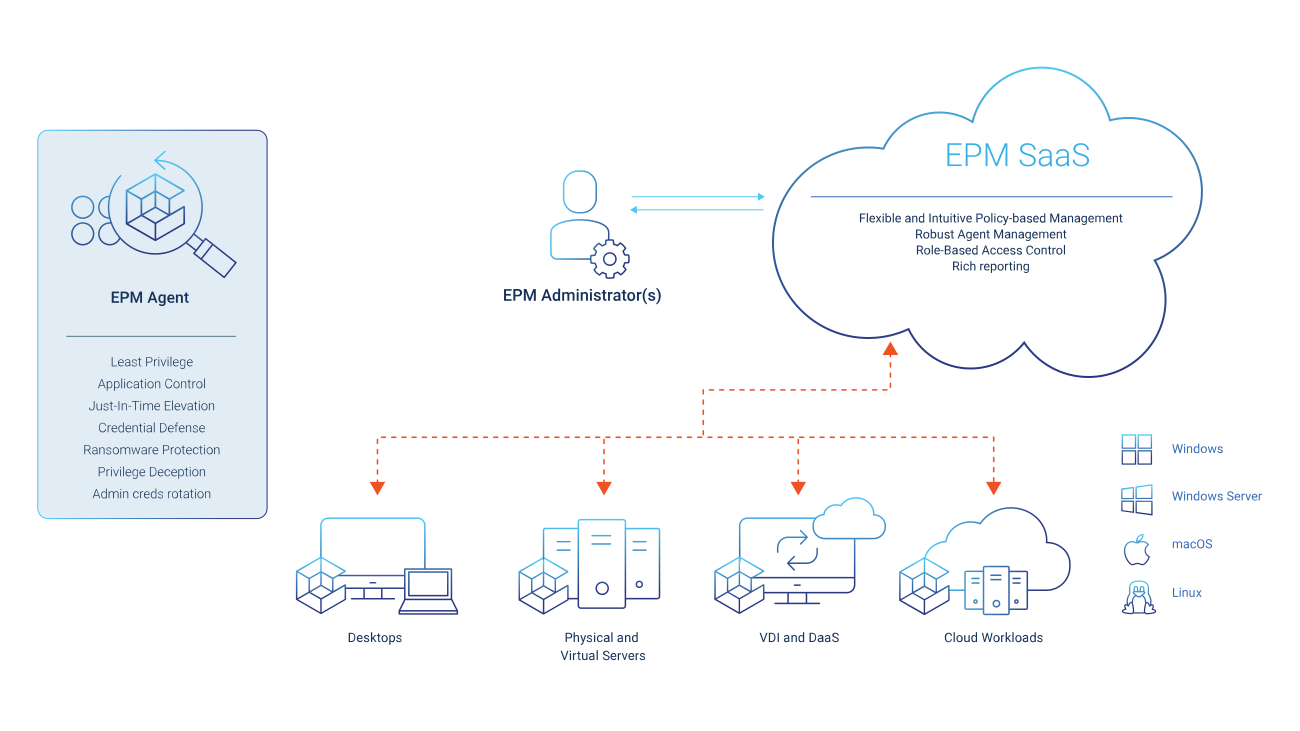
CyberArk Endpoint Privilege Manager (EPM) is a privilege elevation and delegation (PEDM, aka Endpoint PAM) that provides critical building blocks for a mature endpoint security solution/stack helping organizations reduce the risk of cyberattacks by managing and securing privileges on endpoints like desktops, laptops, and servers. It enforces the principle of least privilege by removing excessive user permissions (like local admin rights) and controlling which applications can run and what actions they can perform.
EPM contributes in several key ways:
- Reduces the attack surface: By removing unnecessary local admin rights, it limits the potential for attackers to gain control of a system.
- Implements foundational intelligent privilege controls: EPM protects from identity- and privilege-based attacks targeting and originating on endpoint, extending identity security and Zero Trust to endpoint.
- Protects against ransomware: It includes out-of-the-box policies specifically designed to protect against and limit ransomware impact by controlling access to sensitive data.
- Prevents credential theft: It detects and blocks attempts to steal credentials, passwords, and security tokens stored in operating systems and browsers.
CyberArk EPM is an integral part of CyberArk Identity Security Platform:
- True micro-service-based cloud solution
- Single management console and single agent
- Thousands of real implementations, protecting the largest organizations world-wide
- Out-of-the-box templates, policies and frameworks to get you up and running in no time
- CyberArk Blueprint and Success Path frameworks to operationalize best practices and streamline implementation
- Repeatedly recognized by industry analysts as a leading solution
CyberArk EPM provides protection for workstations and servers running on Windows, Windows Server, macOS, and Linux.
EPM offers a comprehensive set of features to secure your endpoints:
- Local Admin Rights Removal: Securely removes standing administrator privileges from users to minimize risk.
- Least Privilege Enforcement: Ensures users and applications only have the permissions necessary to perform their roles.
- Application Control: Uses comprehensive, flexible, policy-based controls with granular ring fencing to allow, elevate, block, or restrict applications. Unknown applications can be run in a “Restricted Mode” (ring-fenced) to prevent them from accessing sensitive resources or the internet.
- Just-In-Time (JIT) Elevation: Allows users to request temporary, audited access to elevated privileges for specific applications or tasks when needed, without granting permanent admin rights.
- Credential Theft Protection: Actively detects and blocks attempts to steal credentials from Windows and popular web browsers.
- Ransomware Protection: Provides dedicated policies to protect against ransomware by controlling file access and blocking common attack patterns.
- Linux Sudo Management and Identity Bridge: Centralizes and simplifies the management of sudo commands on Linux systems to enforce role-specific least privilege at scale. Integrates Linux with centralized accounts in Active Directory (AD-Bridging) and cloud identity providers via open industry protocols (Identity Bridge)
Once local admin rights are removed, EPM automatically and transparently elevates the privileges for trusted applications that require them based on policy, allowing users to remain productive without compromising security and enforcing the least privilege. For unhandled applications, users can request elevated access, which is then audited.
Yes. While bringing a unique vale to the table, EPM is designed to be part of a broader security ecosystem. Thanks to support of open industry standards and integrations with our technology partners It can send unknown applications to threat detection solutions like Palo Alto Networks WildFire®, Check Point, and FireEye for analysis. It also integrates with SIEM platforms through REST APIs to centralize event auditing, complementing tools like Cortex XDR and Cortex XSIAM by providing a foundational layer of privilege security.
EPM is designed for rapid deployment and quick time-to-value. It is delivered as a SaaS solution, which avoids the need for on-premises infrastructure. It also includes a set of out-of-the-box default policies (QuickStart policies) that can be activated with minimal configuration to immediately reduce risk by removing local admin rights, protecting credentials, and guarding against ransomware. CyberArk also offers a tried and proven deployment roadmap called Blueprint created to replicate and scale the success of many enterprise deployments over the years.
EPM helps integrate Linux with centralized accounts in Active Directory or modern cloud-based directories, allowing use of the same directory account for Linux login with strong phishing-resistant MFA and modern authentication methods. EPM also helps centralize and automate the management of sudo rules, eliminating the need for manual, error-prone editing of sudoers files. Using a “Learning Mode,” EPM can discover which privileged commands users need and why, allowing administrators to create and enforce granular, role-based policies for least privilege access across all Linux systems.
Yes. By enforcing the principle of least privilege, removing local admin rights, and providing detailed audit trails of all privileged activity, EPM helps organizations meet the requirements of various federal mandates and industry regulations. It aligns with security frameworks like the NIST Cybersecurity Framework, MITRE ATT&CK®, and supports key tenets of a Zero Trust architecture as outlined by directives like Executive Order (EO) 14028.
Endpoint Privilege Manager Interactive Product Tour
Learn how Endpoint Privilege Manager can help your organization reduce the risk of identity-based attacks on endpoint with capabilities including:

Discovery and removal of local admin rights and flexible policy management to help secure the organization while optimizing IT operations
Enforcement of least privilege controls to extend identity security and zero trust to endpoints
Defenses against ransomware with out-of-the-box policies for protection
Reporting for better visibility and to satisfy audit and compliance standards
With our interactive product tour, you can experience first-hand how EPM, as part of Endpoint Identity Security strategy, can help your organization secure endpoints and servers, without disrupting productivity.
Sign up now to get immediate access to our EPM Interactive Product Tour!


